
Music is all about freedom of expression; however, if external noise disrupts the creative flow during the music creation process, the outcome may not be as desired. While your beats may disturb your neighbours, you might also want calm and peace while working in your studio. Soundproofing the music studio will help in creating a calm environment, which gives the artist creative independence. For soundproofing in Surrey, contact professionals who can provide expert soundproofing solutions.
Tips to soundproof your music studio
Understand the basics of soundproofing
To soundproof the studio, focus on two key goals. Firstly, you need to block the sound coming from outside, and secondly, you need to control the acoustics inside the room. Professionals will consider both aspects, and with the help of the right design layout and materials, they will soundproof the music studio and create a professional environment.
Also, Read this Blog: How to Soundproof Your Home Office For Better Focus and Productivity?
Close all gaps
If there’s even a minor crack which can let the sound escape, then it should be sealed. While soundproofing the studio with the right materials, it is also necessary to conduct a thorough inspection of the cracks and gaps in the doors, windows, and electrical outlets. With the help of acoustic sealant and airtight seals, these cracks can be effectively sealed. Once all the cracks are sealed, the studio will be soundproof.
Use acoustic panels and bass tapes
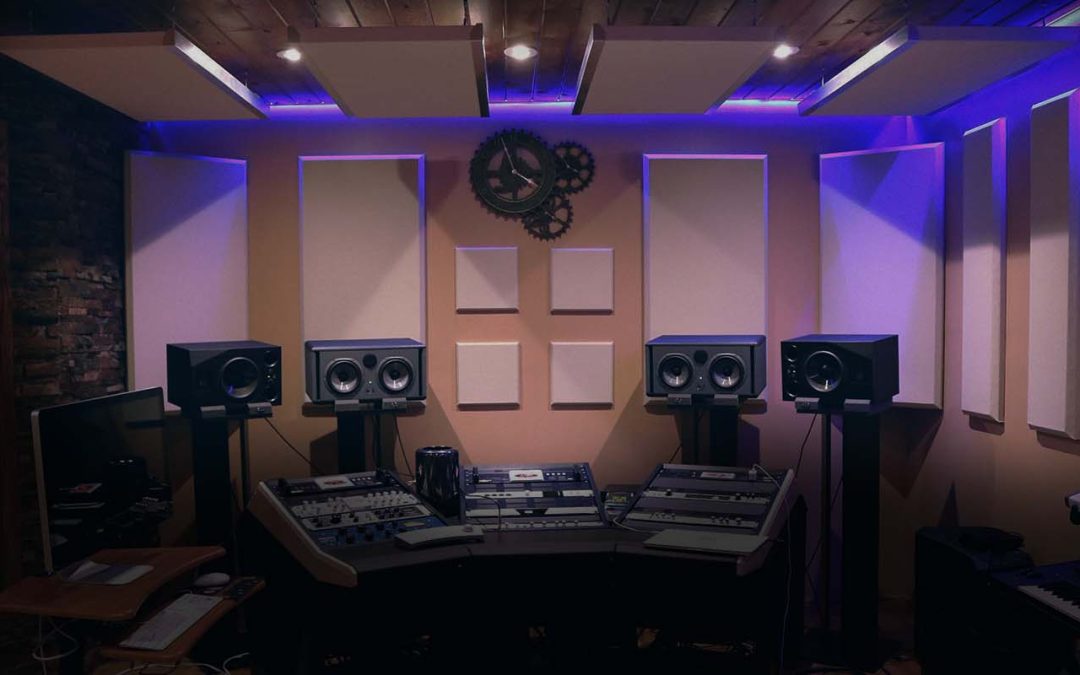
Installing acoustic panels around the studio will help absorb mid-to-high sound frequencies. Moreover, these panels help to reduce echo and improve sound clarity. Along with them, installing bass traps around the studio will help to control low-frequency sound buildup. This will help in getting sound clarity during the recordings. The traps are also placed around the corners of the studio room and on the walls to make a dramatic experience with the sounds.
Install double-glazed windows
Double glazing helps in preventing noise generation inside the rooms. Additionally, installing solid-core doors in the studio will significantly reduce sound leakage from inside. Furthermore, you can add heavy curtains, as this will help further dampen the noise. Sound can also travel through vibration. Hence, decoupling the walls and floors is also a useful technique that helps in preventing vibrations.
Balance the internal noise
Once you’ve taken care of the external noise, give attention to the internal noise. With the help of diffusers, foam panels, and furniture placement, you can create a balanced and natural sound environment. This is essential for accurate mixing and recording of sounds.
Take care of the flooring
Hard floors are not suitable for sound mixing. They reflect sound and create an echo, which does not produce the desired sound type. If your studio has a hard floor, use carpets and thick rugs to cover it. This will absorb the noise. For optimal sound isolation, consider using insulated materials for the floors.
To soundproof a music studio, you need technical know-how, and hence hiring a professional is essential. Contact Soundproofing UK. With 20 years of experience, we provide top-tier soundproofing installations and a comprehensive range of premium materials.
