
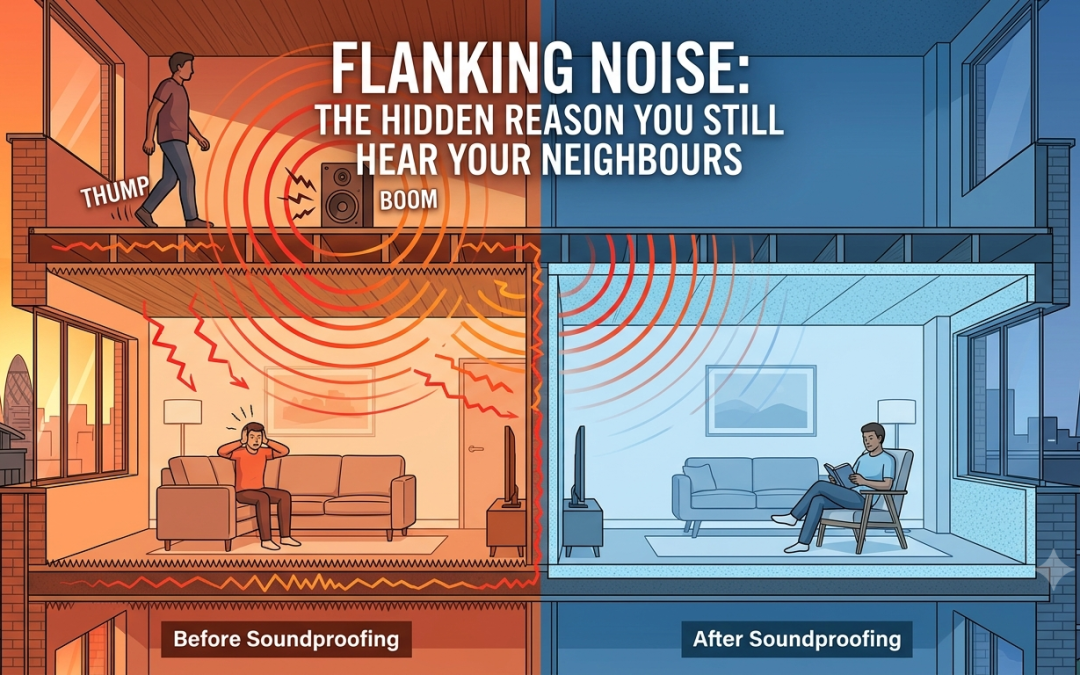
You’ve probably done everything right: used thick curtains, rugs on the floor, and maybe even looked into soundproofing walls in London to keep the noise out. But you can still hear your upstairs neighbour's footsteps, or the faint thud of bass from the flat next door. This is indeed quite frustrating, especially when you are trying to find some peace/ sleep. That said, the culprit is often something most people have never heard of: flanking noise.
What Is Flanking Noise?
Sound is much like water. If you block one path, it finds another route to travel through. That’s exactly what flanking sound is. It is the sound that sneaks around, above, or below a barrier rather than passing directly through it.
In a flat, every wall, floor, and ceiling is connected. In fact, the flats have a shared skeleton in the form of the building's structure. So, when your neighbour slams a door or plays loud music, the sound/ vibrations travel through these shared beams, joists, and concrete into your rooms. This makes flanking noise a sneaky problem.
Why Does This Matter for Soundproofing?
A lot of people invest in soundproofing and yet feel disappointed with the results. According to experts, flanking noise is usually the missing piece of the puzzle. So, if you treat one surface/ wall, you’re solving only half the problem at best. It is much akin to patching a single hole and wondering why the water still pours out.
Flanking noise is quite common in older builds, converted period properties, and flats with lightweight construction. The floors, ceilings, pipes, and even skirting boards can all carry sound from one space to another. This is exactly why soundproofing walls in London needs to be approached as a whole-room problem.
How Is Flanking Noise Actually Dealt With?
Dealing with flanking noise properly requires a good understanding of where the sound is entering from, and that’s not always obvious to the untrained eye. This is why you need to reach out to professionals who are acoustic specialists. They assess not just walls, but also the junctions where walls meet floors and ceilings, how pipework runs through the building, and what the underlying structure is made of.
Based on the assessment, they put together a solution that addresses all the paths sound could take. Some of the common techniques include using acoustic isolation mounts, adding dense mass-loaded materials, and decoupling new wall or ceiling layers. When done right, the difference is remarkable.
Key Takeaway
Flanking noise is one of those invisible issues that can undermine your efforts of creating a peaceful home. If you're living in a flat and struggling with noise despite previous attempts to fix it, it may well have a role in it. This is why you should give soundproofing walls in London some serious thought, and make sure that it is done by someone who understands acoustic pathways.
At Soundproofing UK Ltd, we've been designing and fitting professional wall soundproofing systems since 2003. We're Guild of Master Craftsmen accredited and Checkatrade approved, so you can feel confident you're in safe hands.
Tired of hearing your neighbours through the wall? Get in touch with us.
